
Where are the men?
What a ₹370 biryani joke, the manosphere, and the success of Off Campus and Obsession reveal about the conversations men aren't having

For readers outside India who missed the latest episode in our national circus of misogyny dressed up as banter, a clip from comedian Pranit More’s stand-up show recently went viral. During a crowd-work segment, an audience member, Himanshu Jangra, began talking about a date. He had taken a woman out, paid ₹370 (~£2.90 / $3.80) for her biryani, and when she later wanted to go home, suggested that this was somehow unacceptable because he had spent money on her.
He used the word vasooli, which is an untranslatable Hindi word that means something close to recovering a return on investment or getting back what is owed. You might use it for a debt or a bad film you want to extract some value from because the ticket was too expensive. But here it was being used for a woman; more specifically, for sexual entitlement. The implication was clear enough to everyone in that room: I paid for dinner, therefore something is owed to me.
After the clip went viral, there was outrage, an apology, a firing, and then the familiar second-order debate about consequences, cancellation, and whether a young man’s life should be damaged over one obscene joke. But what I still can’t get my head around is not just what Jangra said, but the room full of other men who laughed throughout the punchline. Before the outrage and the firing, the room rewarded him.

Sukhmani Malik, writing recently in The Indian Express about the surprising success of the campus romance Off Campus and the horror film Obsession, helped me understand why the reaction of that room stayed with me. Her argument is that both works are responding to women’s exhaustion with the manosphere, though they do so from opposite ends of the emotional spectrum. Off Campus offers a fantasy in which men are emotionally literate, attentive, and capable of treating women as equals; Obsession, which I saw yesterday, explores what happens when loneliness, entitlement, and resentment curdle into something darker. The film is, as Ekta Sinha writes in Elle India, a “grotesque metaphor for [the] entitlement of men believing women can be emotionally manufactured into loving them back.”
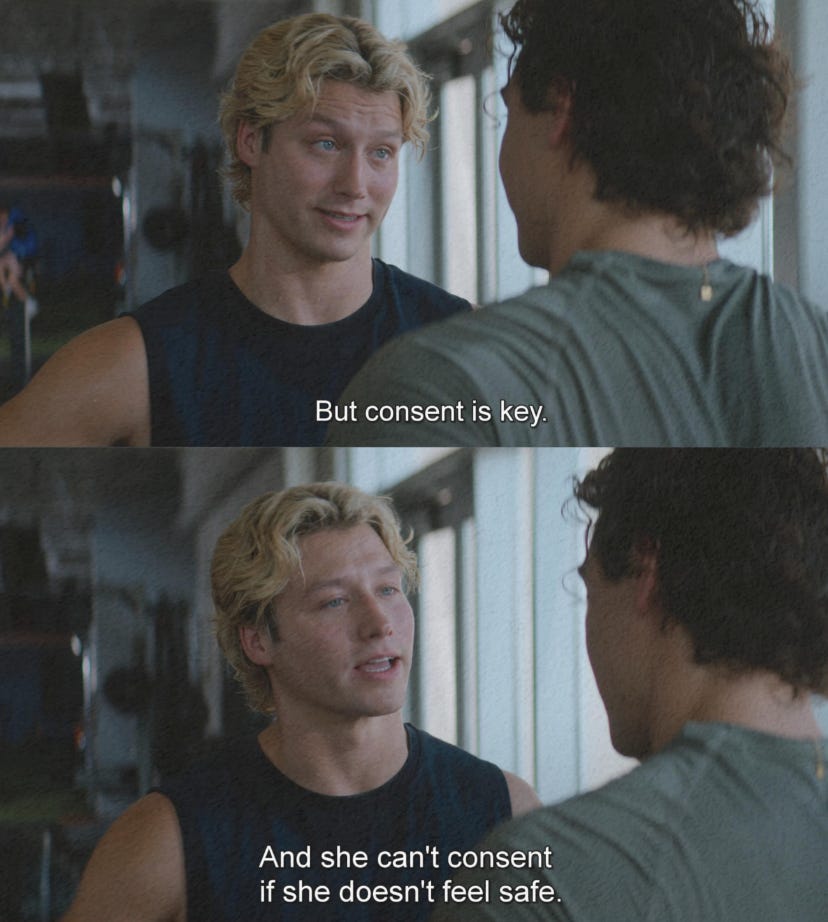
I haven’t seen Off Campus yet, but the pull, a friend told me, wasn’t just the handsome hockey players or the romance plot. There is a scene, she said, where two male characters speak to each other about consent in a gym when there are no women in the room. That, to her, was the ultimate fantasy: Men speaking to other men about consent.
That observation stayed with me because it seemed to answer the question I had after watching the biryani clip. What happens when conversations about healthy masculinity are happening everywhere except between men themselves?
In a recent interview with Ezra Klein, the journalist Helen Lewis talks about “masculinism”: the broader ideological project gathering around the manosphere. Lewis’ point is that this is no longer only about influencers like Andrew Tate selling protein powder, dating advice, and resentment. There is a more coherent political worldview emerging behind it; one that sees feminism as a mistake, equality as a failed experiment, and modern society as having somehow emasculated men.
Once you start looking for it, that nostalgia is everywhere. A longing for a time when men were men and women were women. A time before women entered the workplace in large numbers, before divorce became easier, before the family became more negotiable, and before gender became something people could negotiate rather than unquestioningly inherit.
In the American version, as Klein and Lewis discuss it, this nostalgia often fixes on the 1950s: here, the archetype is the ordered household that has a male breadwinner, a female homemaker, and a ‘happy’ suburban family. At other times, it wanders further back: to Sparta, Rome, Christian patriarchy, or whatever other era can be brought up to serve the point. The details keep changing but the vibes do not: modernity has gone wrong because men are no longer man enough and women are no longer woman enough.
The Indian version I have seen recently tends to revolve around “family values”, “our culture”, the rising divorce rate, the decline of marriage, the idea that women have become too independent and men have become too soft. It surfaces at family events and in WhatsApp forwards, in jokes about women who earn too much or refuse to “adjust” or in the idea that every failed relationship is another data point in evidence of civilisational decline.
In both these contexts, much of the longing attaches itself to real anxieties. Families are changing; marriage is changing; dating is genuinely confusing. Yes, many men are lonely and many women are exhausted. Most of us are navigating relationships without the older certainties that once organised family and obligation. A man may no longer know what he is supposed to be and a woman may no longer be willing to become what others expect of her.
But the cure being sold is wrong: women have become too free, men have become too soft, and so we need to restore an older order where men are providers and women are dependents. The answer, still, is patriarchy with a podcast mic.
Much of this feels less like a recovery of tradition than an invention of it. The historian Eric Hobsbawm has pointed out how many “ancient traditions” turn out to be surprisingly recent constructions. The past becomes a repository for present anxieties. We imagine a simpler world, then go looking for evidence that it once existed.
This is what bothers me about so much talk of traditional masculinity, because which traditions are we actually talking about? The American suburban father? The Roman patriarch? The Spartan warrior? The Hindu householder? The village elder? The king? The monk? The ascetic? The poet? The man who renounces the world or the man who rules over it?
They are not the same person.
And yet, in the online imagination, they get flattened into one figure: dominant, heterosexual, cisgender, physically strong, emotionally contained, sexually successful, obeyed by women, admired by men, and always, always, always, certain of his place.
The sociologist R. W. Connell coined the term “hegemonic masculinity” to describe the culturally dominant ideal of manhood against which other men are measured. Crucially, she says, this ideal is often unattainable. Most men are not exceptionally wealthy, powerful, stoic, dominant or sexually successful. Yet the ideal still shapes behaviour because it becomes the standard by which men judge themselves and each other. Seen through that lens, the problem with the manosphere is not simply that it promotes a particular model of masculinity but that it promotes an exaggerated and increasingly brittle version of hegemonic masculinity while presenting it as natural and universal.
The rules are thus: A man must dominate, provide, and not be rejected. He must not be laughed at or be feminine. He cannot need reassurance or be confused. Oh, and he must certainly not admit that he is lonely unless that loneliness can be turned into an attack against women.
What this masculinity cannot do is tell a man what to do when he is not chosen or not powerful enough. The man has no inner life except grievance and the only language he is taught is that of blame. And almost always, the blame lands on women.
Most of us know this man. He may be a friend, a relative, a coworker, or the loudest voice in a WhatsApp group. And if we are honest, most of us have also been in the room when someone said something similar and decided it wasn’t worth challenging.
What makes this stranger still is that our own religious teachings — the same ones used by the Right when they talk of traditions — have rarely imagined masculinity so narrowly.
In an Indian context, Shiva is perhaps the most obvious example. He is terrifying as Bhairava, yes, but he is also Nataraja, the cosmic dancer. He is the destroyer, yes, but also the ascetic and husband, a yogi and a householder. In Ardhanarishvara — the form where Shiva and Parvati share a single body — masculinity is not made impure by the presence of the feminine. It is made whole instead.
Take Krishna too. He is a divine playboy who is adept at playing the flute and charming women, but he is also a friend, a strategist, a diplomat, a teacher, a child, a God. The emotional world around him is not built on conquest alone. It is built just as well on longing, intimacy, and surrender. The Bhakti imagination does not seem nearly as afraid of tenderness as many modern men are.
Even the Mahabharata, begins its most famous philosophical moment with a man falling apart. The great warrior Arjuna is standing on the battlefield and cannot go through with the war. His body starts trembling, his mouth dries, and his bow slips from his hand. He is not shown weak because of his hesitation; if anything, there would be no Gita without a man publicly acknowledging he is having an emotional breakdown over a moral dilemma.
Even outside India, the past is messier than the masculinity influencers want it to be. The ancient Greeks and Romans whom they like to invoke had their own brutal hierarchies and misogynies, but their worlds also contained forms of male intimacy and dependence that do not map neatly onto today’s anxious heteromasculinity. Achilles and Patroclus have been read more recently not only as comrades but as lovers. The point is not to paste modern identities onto ancient figures. It is to acknowledge that the past was never as clean as the people selling “traditional masculinity” pretend.
The old epics were often more complicated than the new podcasts.
That is the real giveaway. The men who talk most loudly about tradition often seem to know the least about it. They want the father, the warrior, the patriarch, and the king. They do not know what to do with the dancer, the mourner, the friend, or the devotee. They do not know how to hold space for the man who listens, the man who loves, the man who yearns, or the man who, to borrow from Walt Whitman, “contain[s] multitudes.”
Male loneliness is real. I am not waving it away. But it’s equally true that women did not create it by becoming freer and they are not responsible for curing it by becoming smaller. What the manosphere does is take a real anxiety and attach a false cause.
When the biryani clip went viral, women did most of the explaining. They explained the misogyny inherent in the entitlement and used dark comedy to point out that their sanitary pads or lip gloss cost more than Jangra’s biryani. They said, again and again and again, that paying for dinner does not create a debt.
But they shouldn’t have to. The room should have gone quiet when a man said he would recover a ₹370 investment via a woman’s body. It didn’t. So the question is not just what kind of man says something like that. It is what kind of men laugh when he does.
And what happens when conversations about masculinity are happening everywhere except between men themselves?
And that is why I ask, where are the men?
So well-articulated and you've also done a great job at dissecting the situation and going deeper into exploring "masculinity" with receipts.
It was so refreshing to read a perspective so in tune with some of my thoughts that somehow get choked in conversations with the men in my life who don't care to listen to me when raising questions about how unfair it is for them in modern times.
Thank you for documenting this in such a great manner.
I hope this reaches more men! And yes, the conversation on consent was the most touching scene in Off Campus, stood out to me too.