

Note from the road: I’ve been on the move these past few weeks and haven’t been able to publish my usual longer essays, though a lot of writing has been happening behind the scenes. For now, I wanted to share this review of a recent book that stayed with me — a sharp, unsettling work that feels especially relevant to the moment.
The Robe and The Sword by Sonia Faleiro
Fourth Estate India, December 2025
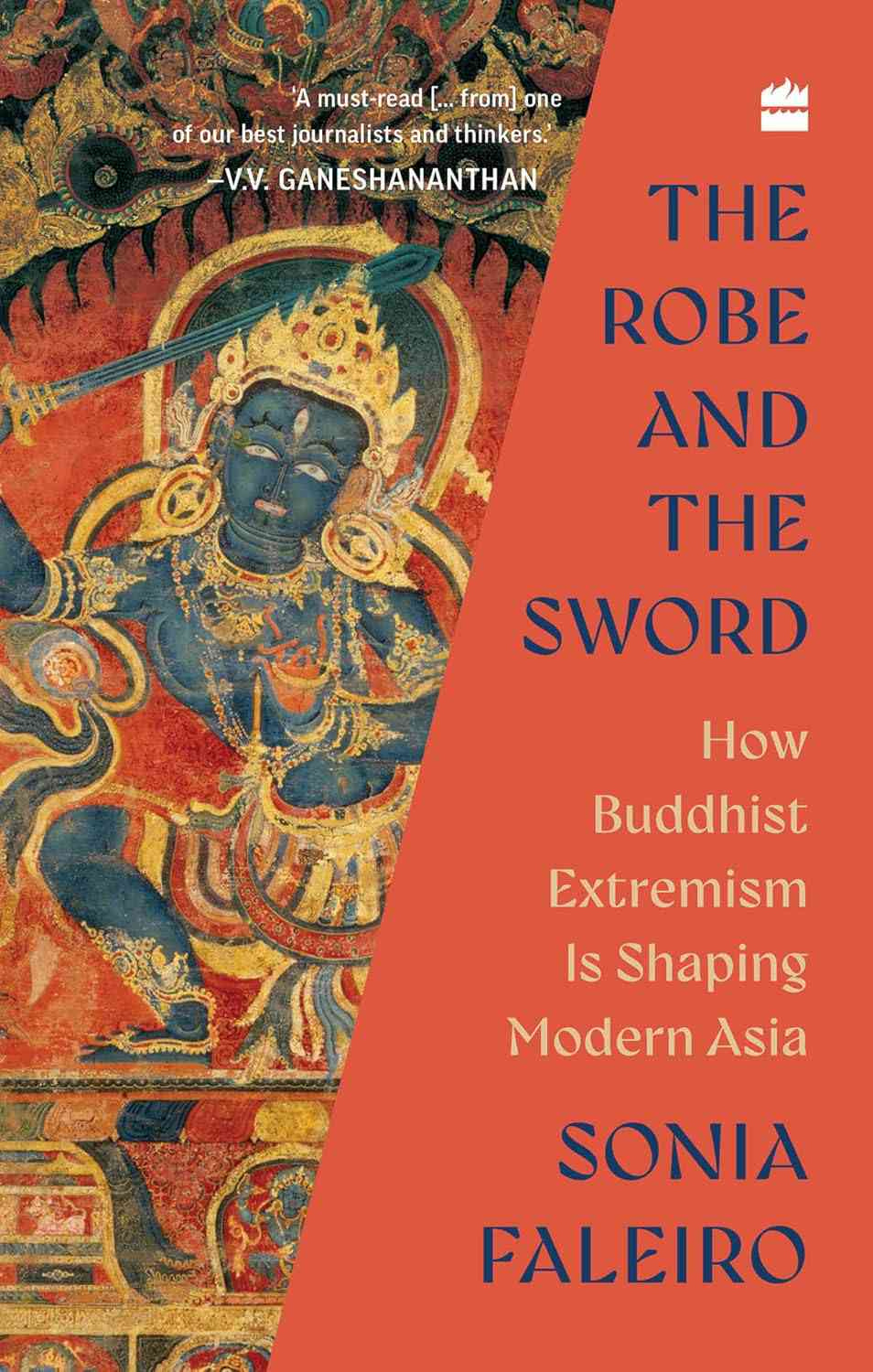
Buddhism travels well. In the West, it has found an afterlife in the mindfulness aisle: wrapped in incense, translated into wellness, reduced to a symbol of zen and calm in a distracted, overworked world. It is often imagined as the peaceful religion, insulated from the fanaticism or violence we associate with others. Sonia Faleiro’s The Robe and the Sword dismantles that comforting fiction.
“Attaining nirvana can wait,” declares Galagoda Gnanasara, a Sri Lankan monk and leader of the Buddhist nationalist organisation Bodu Bala Sena. The remark came in the wake of anti-Muslim rhetoric and violence, and its power lies not in what it rejects, but in what it prioritises instead. In Faleiro’s account, this fusion of sacred duty and worldly domination is the engine driving militant Buddhist nationalism across South and Southeast Asia.
Faleiro’s book is a calm, deeply reported account of how Buddhist authority — or more precisely, institutions speaking in its name — has been harnessed to defend majoritarian dominance across Sri Lanka, Myanmar, and Thailand. The robe, in her telling, is not a veil but a uniform: a garment that lends sacred legitimacy to acts that would otherwise look indefensible. “The monks leading these violent movements,” she writes, are “driven not by a pursuit of nirvana in the next life, but by a quest for dominance in this one.”
Structured in three parts — one per country — the book blends journalistic rigour with the accessibility of narrative nonfiction. What emerges isn’t simply the story of Buddhist extremism, but the machinery that enables it: the sacralising of the nation, the invention of enemies, the rhetorical laundering of violence into moral duty.
The Sri Lanka section is the most developed. Since independence, the island’s Sinhalese Buddhist majority has increasingly positioned itself as both guardian and embodiment of the nation. The Sinhala-Only Act of 1956, often remembered as a linguistic policy, becomes in Faleiro’s telling something more foundational: the state’s first major gesture of exclusion, forcing minorities to learn a language that was never theirs.
What’s most unsettling is how adaptable this architecture of fear proves to be. For decades, the Tamil Hindu was the primary object of suspicion. After the LTTE’s defeat in the country’s decades-long civil war, that narrative didn’s disappear but mutated — the Muslim, and to some extent the Christian, began to replace the Hindu in the national imagination, recast as proxies for invisible networks and global conspiracies. After all, “Sri Lanka,” as one Reuters journalist tells her bluntly, “always needs an enemy.”
Faleiro shows how theology bends to serve power. Ahimsa, the principle of non-violence, is not discarded so much as edited, with exceptions made to uphold dharma. The Mahavamsa, a sixth-century chronicle, is deployed to argue that Sri Lanka was chosen by the Buddha himself to protect his teachings, and therefore those who endanger Buddhism endanger the island. Violence, in this worldview, becomes not only permissible, but righteous.
In Myanmar, religion and nationalism were entangled from the start. Under British rule, Indians — Hindu and Muslim — were brought into Burma as clerks, traders, and labourers. They became visible in ways native Burmese, systematically excluded from certain colonial privileges, were not.
One of the book’s most quietly striking details concerns U Ottama — the monk once dubbed the “Burmese Gandhi,” who at one point led the Hindu Mahasabha. There is something almost shocking about that porousness now, the possibility of cross-religious political affiliation, a throwback to the shared struggle against colonial rule. What replaced it wasn’t merely a rigid identity, but suspicion: the sense that anyone with divided loyalties might be an agent of something larger and dangerous. This hardening of boundaries is the soil in which later horrors grew.
By the time Ashin Wirathu, leader of the 969 Movement and dubbed “the face of Buddhist terror” by TIME magazine in 2013, rose to prominence, the architecture was already in place. His sermons gave spiritual sanction to the military’s persecution of the Rohingya, dehumanising an entire population before expelling them. The colonial regime’s extractive footprint — Burmese bodies used to fight imperial wars; teak, gemstones, and labour siphoned out — becomes a backdrop for why postcolonial identity hardens the way it does, but Faleiro is careful not to let history become excuse.
What links Sri Lanka and Myanmar, then, is the colonial wound: the sense that supposed “outsiders” were privileged while the true sons of the soil were sidelined, and that independence meant not just political sovereignty but the restoration of a Buddhist order, with the robe becoming the garment of reclamation.
Thailand, the third case study, sits differently. Never formally colonised, it lacks the same postcolonial grievance narrative — and yet Buddhist nationalism persists, suggesting the pattern is not reducible to colonial trauma alone. Here the alliance of monarchy and sangha is longstanding, and Faleiro is good at showing how it shapes the moral order. One of her most useful observations concerns how hierarchy is literally staged in ritual: in Myanmar, monks are seated above the military, while in Thailand, it is the king first, then the royal family, and only then the monks. Even sacred authority has its rank order. If there is one critique, it is that this section feels more subdued and somewhat compressed into the frame established by the other two — Thailand’s particular entanglement of crown, military, and clergy might warrant a different kind of attention.
Overall, though, Faleiro also surfaces a less discussed layer of this story: Buddhism’s patriarchal scaffolding, particularly in Theravāda traditions. Male monks hold institutional power and privileges systematically denied to women, from legal recognition to ordination to education. These hierarchies matter because they show how extremist monks aren’t anomalies operating outside the system, but are amplified by a structure already primed to elevate certain voices and silence others.
Faleiro doesn’t argue that Buddhism is uniquely vulnerable to violence. Her point is that no religion is exempt from the temptation to serve power. She neither demonises monks nor romanticises minorities, but questions what happens when statehood is draped in sanctity, when nationhood is sermonised, when law gives way to liturgy?
This feels particularly urgent now, in a world where religious nationalism has become one of the most portable ideologies on earth. The Robe and the Sword shows how extremism rarely arrives with fanfare. It creeps in sanctified and sermonised, dressed in virtue. Faleiro’s achievement is to show that the robe is not always what it appears to be — that the aesthetically pleasing version carried to the West is part of the story — and that sometimes, the most effective weapon is the one that looks like peace.