The spice that built the modern world
How the empire of pepper changed India (and my family)
“Saale!” A voice explodes down the aisle. “Abhi nahi! Khana chal raha hai!”
I look up from my book. The train conductor is red-faced, shouting at a young man with plastic bags full of chips and biscuits — an unauthorised vendor moving through the compartment like a loud ghost. Usually conductors ignore them, but this one is furious about the timing because the official dinner service is making its rounds, and he’s worried this intruder will undercut the sanctioned meal.
The vendor retreats. The conductor smooths his uniform. Order is restored.
And then my meal arrives — dal, rice, chickpeas glistening with oil, two soft chapathis, and a small dollop of pickle — the exact meal I’ve eaten on a dozen trains, filling and comforting in its simplicity. I tear off a piece of chapathi, mix it with the chana, take a bite.
Something feels wrong. Not exactly bad, just absent.
I eat slowly, searching for what’s missing, and halfway through the rice it hits me: pepper. There’s no pepper. The dal has turmeric, asafoetida, and cumin, the chickpeas have coriander and chili, but none of that sharp, complex heat that wakes up the back of your throat. The irony is almost perfect, for here I am, rolling through the night from Goa toward Kerala, on the stretch where pepper grows in abundance, eating a meal whose blandness only proves the spice’s importance.
How something can be everywhere and nowhere at once, how the thing that once reshaped empires now passes unnoticed until it’s gone.
It started hours earlier, as the train pulled out of Madgaon at dusk, that hour when light seeps into the Goan hills and blurs their edges into shadow. Third AC, eight berths to a section, and I’d lucked into a side lower which means only one bunk above me instead of two. The compartment settled into its familiar symphony almost immediately: a Tamil family across the aisle negotiating dinner plans, Malayalam rising and falling behind me like water over stones, a child laughing somewhere high and bright, metal tiffin containers clanking as someone rearranged luggage overhead. This multilingual hum, languages bleeding into one another at the borders, everyone occupying the same space but existing in different sonic universes.
A man slid into the berth across from me — Punjabi, probably, from his demeanor and given the train originated from Amritsar, phone already glowing in his hand. Within seconds the compartment filled with the staccato assault of reels: ten-second bursts of Punjabi bleeding into Haryanvi bleeding into Marathi bleeding into English pop, layered over the Malayalam conversation behind me, the Tamil negotiation across from me, the rhythmic clack of the wheels below, and I thought to myself that silence in India has become an endangered species.
I tried to focus on my book about Kerala, but couldn’t concentrate — the noise, the movement, the darkness pressing against the window all conspiring against me, and my mind started to wander to pepper. This utterly ordinary thing, this spice that sits on every table in cheap plastic shakers, was once the most desired substance in the known world, more valuable than gold; it was the thing that launched a thousand ships, that redrew the map of everything, that the ancient Indians called Yavanapriya — the “favourite of the Greeks.”
It was Europe’s obsession with pepper, writes historian P. H. Freedman in Out of the East: Spices and the Medieval Imagination, that catapulted its colonial ambitions and led it to become “a force that remade the demography, politics, culture, economy, and ecology of the entire globe.” But ask most people, especially those outside of the Subcontinent about this spice, and many know very little. And that’s because, so often, ‘world history’ is really just Europe’s history with the volume turned up, everything else relegated to footnotes, and I find myself thinking about how thoroughly we’ve internalized this hierarchy, billions of us remaining perpetually regional while Europe gets to be universal.
But pepper was never local. This is what keeps pulling me back: the way a spice that grew along the Malabar and Konkan Coast — from Goa down through Kerala — became the hinge on which the entire world turned.
The Periplus of the Erythraean Sea, written by a Greek merchant almost two thousand years ago, describes Muziris — believed to be near modern Kodungallur just north of Kochi on the Malabar coast— as a port of “leading importance.” Archaeologists have since found Roman amphora and glass, and Chinese porcelain there, proof that Kerala was global long before globalisation had a name. Ships from Arabia and the Red Sea docked for pepper long before Europe learned its scent. The Romans called it black gold, and by the first century CE, so much Roman currency was flowing eastward for spices that officials complained India was draining the empire of its wealth. Pliny the Elder wrote bitterly: “There is no year in which India does not drain the Roman Empire of fifty million sesterces.” By the 12th century, pepper was even well established in England, when the Guild of Pepperers was formed in London, which was renamed as the Worshipful Company of Grocers, which is still one of the livery companies of the City of London.
For centuries after, the overland spice trade was controlled by Arab and Venetian merchants; an impossibly complex chain of middlemen, each link extracting its premium. The Venetians especially, who controlled the Mediterranean end, became obscenely wealthy, building palaces and cathedrals that still take our breath away six centuries later, all funded by acting as gatekeepers to Asian spices, and for centuries the dependency was mutual, the system stable.
Then in 1498 Vasco da Gama rounded the Cape of Good Hope and arrived at Calicut, and everything changed.
The train sways around a curve and I brace myself automatically, one hand on the window bar, and I think about that moment, that first encounter, which has become mythic in the retelling but was probably mostly confused and terrifying for everyone involved. Legend has it that the first man to greet da Gama on Indian soil wasn’t Indian, but a Tunisian trader who took one look at the Portuguese ships behind and exclaimed to the mariner, “May the devil take you! What brought you here?”
I empathize with the Tunisian trader — I can imagine he understood immediately, viscerally, what that moment meant — for he must have realised that the entire economic structure of the known world was about to collapse. That his livelihood and the livelihoods of thousands like him were suddenly, catastrophically obsolete. Just a couple of years later, in July 1501, Giralamo Priuli, a prominent Venetian spice trader, wrote in his journal that “the loss of the spice trade would be like the loss of milk and nourishment to an infant.” He added: “When this news reached Venice, the whole city felt it greatly and remained stupified, and the wisest held it as the worst news which could ever arrive.”
By 1506, the Venetian Senate was passing resolutions about the precipitous fall in trade, desperately seeking ways “to provide our citizens with every facility for sailing the seas.”
The axis had shifted, and sitting here with the rhythmic sway of the carriage beneath me, I think about what happened after Calicut, because the Zamorin of Calicut wasn’t impressed with what the Portuguese brought as gifts to the royal court — cheap trinkets, inferior goods, nothing that matched the sophistication of the trade already flowing through his port — so the meeting was a disaster, da Gama was humiliated, and had to go elsewhere; so he went south to Kochi, where a rival king saw an opportunity in this European alliance, and north to Goa.
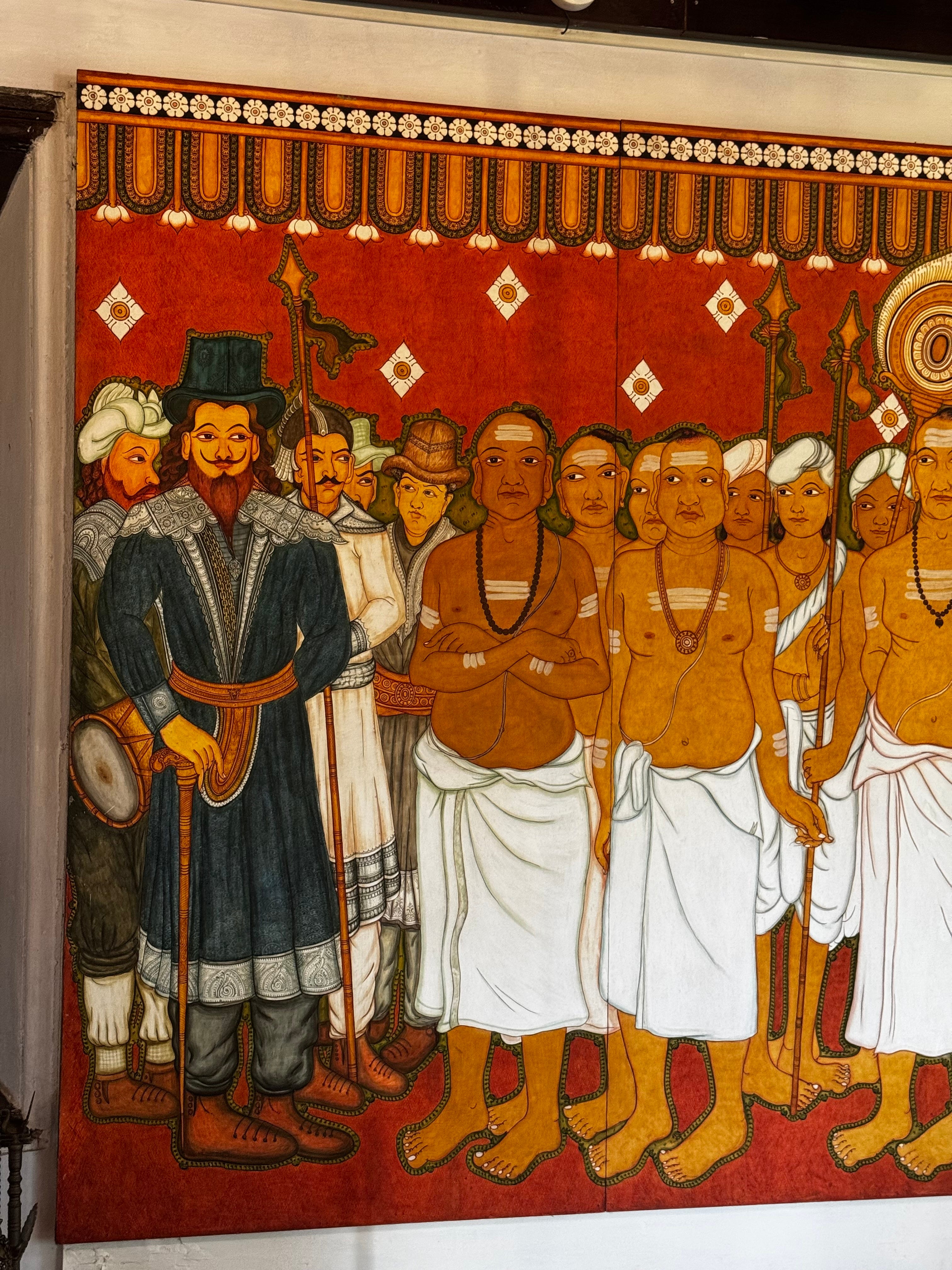
The Portuguese hadn’t just come for spices, but they came to control them. The existing trade on the Malabar Coast was open and competitive: Arab, Jewish, and Indian merchants negotiated prices freely with whoever paid best. Da Gama and his successors saw this very openness as disorder, an affront to what they believed was their divine right to dominate. They couldn’t accept that Indians might sell pepper to Arab traders at a higher rate than to them, so they took by force what they couldn’t secure by trade. By the early 1500s, the Portuguese were bombing ports along the coast, seizing ships at sea, forcing rulers to sign treaties, and installing their own Estado da Índia — the first European colonial government in Asia — to monopolise the spice routes at gunpoint.
To make things worse, they also brought the Inquisition with them, bringing forced conversions and a machinery of religious violence that would run for centuries. Goa became the seat of Portuguese power in India, and with it came the systematic destruction of temples, the persecution of those the Europeans deemed as ‘pagans’, the burning of anyone who refused to convert. Inquisition records even detail abduction of Hindu orphans to be baptized and raised as Christians. Those caught secretly practicing their faith risked imprisonment, torture, or public execution.
But faith does not break so easily. Across Goa, Hindu deities were hurriedly ferried away under cover of darkness. Carved images were wrapped in cloth, cradled like newborns, and carried across rivers and jungles, hidden from the prying eyes of the Inquisition. Back then, my ancestors were one such family, and along with many others, they took the local deity, the idol they’d worshipped for centuries and carried it up into the hills across the border, setting up a new temple in secret, in safety, away from the reach of Portuguese soldiers and Jesuit priests.
And all this started because of pepper. All because da Gama couldn’t get a good deal in Calicut and needed allies elsewhere, because Europeans wanted spices badly enough to sail around the world and then remake it in their image.

The carriage sways gently, a lullaby of metal on metal, and I’m sitting here thinking about this history that runs directly through my blood, through my family’s displacement, through the temple that still stands on that hill in Goa because my ancestors were desperate enough and brave enough to save what they could. This low-grade frustration under my skin: how is it possible that this story isn’t taught in every school, isn’t part of the fundamental narrative we tell ourselves about how the modern world came to be?
This shouldn’t be my story, shouldn’t be local history, regional colour, something tucked away in the back pages of a book about Kerala or Goa. This should be world history the way the World Wars are world history, the way the Renaissance is world history, the way anything that happened in Europe somehow automatically gets classified as universal, as mattering to everyone, while everything that happened here — even when it literally reshaped global trade, toppled empires, launched the entire colonial project — remains particular, specific, ours but not everyone’s.
Most people know Columbus was looking for India when he mistakenly sailed west in 1492, but few stop to ask why. How do we study Europe’s Age of Exploration without centering the thing they were exploring for?
Because here’s what keeps me up at night, what the rocking of this train pulls out of me: the entire architecture of colonialism, the whole blood-soaked edifice of European expansion, was built on the desire to access spices that grew here, along this coast we’re rolling beside through the darkness.
Columbus sailing west and finding the Americas by accident was looking for India; da Gama sailing east and finding the sea route to India was looking for pepper. The Dutch displacing the Portuguese, the British displacing the Dutch, the entire murderous machinery of colonialism grinding forward through the centuries — and at the root of it all, this small black drupe that grows in the red earth along this very coast.
The man across from me stirs, his reels finally silenced, fallen asleep with his phone clutched in his hand. The Tamil family has gone quiet. The Malayalam conversation behind me has softened to murmurs. Even the child has stopped laughing. The compartment fills with the soft orchestra of sleep — snores layering over snores — and I find myself trying to place them. Which ones are Malayalam, which Tamil, which the heavy sleep of long-distance travelers who boarded in Punjab or Rajasthan. A thali of sounds, even in sleep.
I close my eyes and listen to the low metallic rattle of the wheels on rails; this sound that’s the soundtrack to every long journey across India. The Indian Railways, that inheritance of the British empire thrown in the face of anyone who dares criticise the colonial project, used as proof of modernisation, of the civilising mission.
Somewhere beyond this darkness lies the coast where ships once docked for pepper, where Roman traders and Arab merchants and Chinese sailors all converged. I imagine da Gama’s fleet on the horizon, sails ghostly in the dawn, men peering at the green line of land, not knowing yet about the humiliation at Calicut, not knowing they’d find alliance in Kochi and set up base in Goa instead, not knowing their arrival would set centuries of violence in motion — violence that would reach forward to touch my family, my history, me.
History isn’t only made by kings and conquests. Sometimes it’s written in the aroma of a spice, in the simple desire to make food taste better. And sometimes it travels across centuries, to a family carrying an idol into the hills, to a temple still standing, to a man on a night train to Kochi, thinking about pepper.
Outside the window, darkness rushes past in an endless blur, and the steady rhythm of wheels on rails becomes almost hypnotic, pulling me into a dreamy haze where past and present blur together. This should be everyone’s history, not just mine — this story that starts on the Malabar Coast and spirals outward to encompass the world, because pepper changed everything … including me.