
The Mahabharata's hardest lesson isn't about war
It's about what happens when good people stay silent — and why India's students, protesting a leaked exam, are testing whether we've learned it

For months the anger had been building amongst India’s young, and this week it spilled towards the Parliament. What began as a sit-in in the heart of Delhi swelled, over the summer, into a march of thousands. If you are reading this from outside India, the anger is easy enough to recognise even from far away: a generation that did everything it was told to — studied hard, took the degrees, sat the exams, ground through the coaching their families often borrowed to pay for — and found, on the far side of all that effort, no jobs, rising prices, and a rupee worth a little less each year.
The exam that tipped it was NEET, the single national test that decides who studies medicine in India. Close to three million sit it every year, many on a second or third attempt, for a thin band of seats. This May they sat it as they always do — and then, days later, watched it annulled once officials confirmed the paper had leaked. A fresh test was ordered and held weeks later. But the re-test settled nothing, because the leak was not a fault in an otherwise sound machine. It was the machine. Papers have gone out the same way for years now — medical, engineering, police recruitment — with questions sold in online group chats, impersonators sitting in exam halls, centres and dates changed overnight. You can hold an exam again, the protesters said, but you cannot hand a student back the belief that it was ever fair.
And so the protesters wanted accountability. A minister to answer for it. But what they have been handed instead is a change of subject: Who are these protesters, really? Who funds them? Isn’t the whole thing a stunt — aren’t these kids being used? By the time we are done with the questions about the people, the question they came with is still standing in the room, and we have agreed, without quite saying so, to look past it.
In the Mahabharata, one of the most revered figures is Bhishma — the grandsire or ‘Pitāmaha’, the greatest warrior of his age. As a young man he makes an unimaginable vow. To clear the way for his father’s second marriage, he gives up any claim to the throne that would have rightfully been his, swears lifelong celibacy, and binds himself to serve whoever rules Hastinapura for as long as he lives. The heavens rain flowers on him for it and he is granted a boon that allows him to choose the very hour of his death. It is an act of magnificent self-denial.
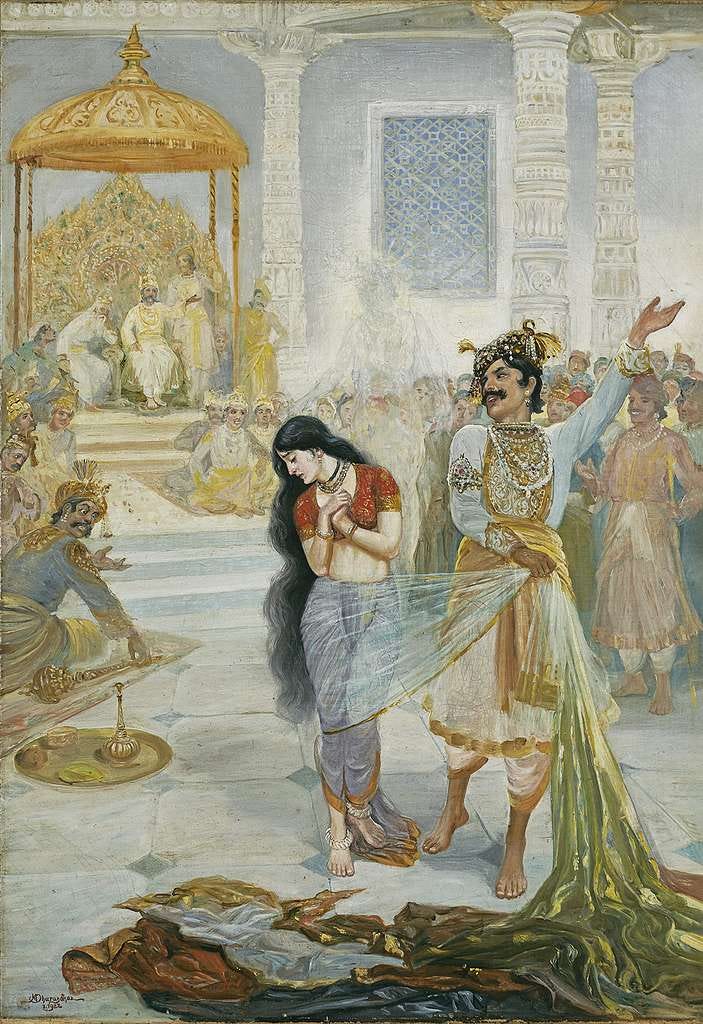
Years later, in the great hall of Hastinapura, a game of dice goes wrong — though “goes wrong” is too kind, because the game was rigged. Yudhishthira, eldest of the five Pandava brothers, is lured into playing against Shakuni, who throws the dice for the other side and cannot lose. Piece by piece Yudhishthira is stripped of his wealth, his kingdom, his brothers, himself, and finally his wife, Draupadi. She is dragged into the court by her hair, and she asks a question. Her husband had already lost himself and become a slave before he staked her, she says, and a slave owns nothing. So by what right was she wagered at all? Was she ever lawfully lost?
The hall goes quiet. The wise men are all there, Bhishma among them, and the room turns to him. He is the most learned of them; his word could end it. But Bhishma will not answer. He says the ways of dharma are subtle, that the matter is too fine for him to rule on with certainty. The greatest man in the room, asked whether an injustice is being done in front of him, takes shelter in the difficulty of the question.
But in that same hall, one man did speak. Vidura — the king’s half-brother — called the game a crime and said so to the king’s face. He was ignored. Not one man in that hall saved Draupadi in the end; she was saved by the divine, while the wise sat and studied their hands.
It is a recognisable kind of failure, Bhishma’s — a sense that the question is too complicated to answer plainly, that the people forcing it are a little embarrassing, that the wise thing, or the balanced thing, is to say nothing.
It is the temptation of every comfortable person watching something like this from a distance. To find the crowd too loud, its leaders too grating, its causes not quite the kind you would want to be seen near. To mistake your own silence for fairness.
You do not have to like these protesters to see that their question deserves an answer. You can find the movement’s name juvenile, its figureheads exhausting, and distrust every influencer and actor who suddenly seemed to care. But a leaked exam is a leaked exam regardless of who is complaining about it. That is what a crowd is, in the end. You can doubt a single person, discredit them, wait them out; you cannot put thousands of them on trial. They are a nurse, a farmer, a girl who sits the exam next year, each there for a private reason and all there for the same one. They are what the development economists have been calling India’s demographic dividend — the largest working age generation — and their frustrations should be met with a discussion, if not a solution.
I am not here to endorse every demand being made on the streets. I do not agree with all of them, and some of the people making them I would happily argue with on another day. But accountability is not a favour a government grants when it feels generous. It is the whole contract. A government owes its people an answer — a real conversation, not a monologue — and when it chooses instead to wait a protest out, to question the motives of everyone asking, to clear the streets rather than deal with what filled it, that is not strength. It is the throne mistaking silence for order. A democracy is meant to survive being questioned. The moment it cannot, something has been lost that no re-test will return.
We revere Bhishma still, and we should. But the epic does not let him off easily. It gives us both his greatness and his failure. When the war comes he fights for the side he knows to be unjust, because his oath binds him to the crown and not to what is right. He is the good man whose goodness is spent entirely in the service of order. And when he lies dying on his bed of arrows, offering long and beautiful counsel on how a kingdom should be run, it comes too late to be anything but grief. He had known the whole time what was right. He had simply promised his loyalty to the throne instead.
We make a smaller version of the same trade every time we treat criticism of those in power as disloyalty to the country. A government is not your family; it is not your blood; it has not earned the silence you would give the people you love. The epic is clear that dharma can ask you to question your own kin — Arjuna puts down his bow on the battlefield and refuses to fight until his conscience is answered, and the whole of the Gita exists because a man dared to stop and ask. And when he did, even God manifested himself on earth to respect the question.
I know people who, watching what is done in its name now, have stepped back from Hinduism — who have started to hear a word like dharma as if it belongs to one side of our politics. I understand the flinch but I don’t share it. A tradition does not belong to whoever shouts for it loudest; it belongs to everyone still willing to embrace it honestly. And read honestly, these stories are not on the side of silence, or of power. I am proud to be Indian and proud to be Hindu, and I would rather reclaim them than hand them over.
The oldest story we have honours the ones who asked the hard questions — Draupadi in the Kaurava court, Arjuna on the Kurukshetra field, Vidura speaking when it cost him — and it mourns the good man who, when his moment came, decided it was wiser to say nothing. So when a great many of a country’s people walk a long way and go hungry to ask it something, the real question is never who they are, or whether we find them agreeable. It is whether those with the power to answer will do the one thing that Bhishma, for all his greatness, could not.