
How do I explain a god with an elephant head to my foreign friends?
On the impossible task of translating a civilisation in real time

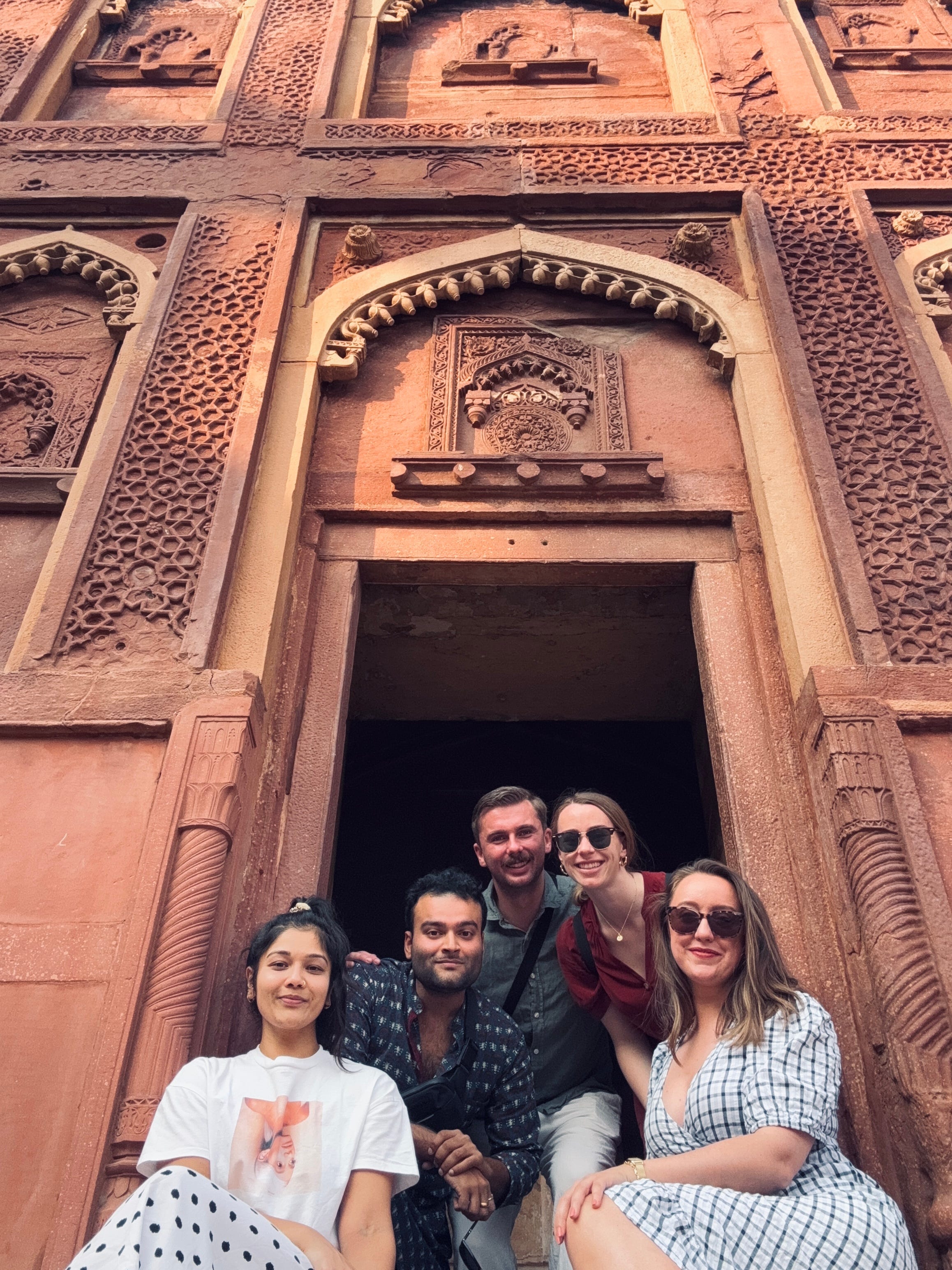
We were inside Hawa Mahal in Jaipur, in a small gallery towards the end where a row of artefacts sits behind a thinning rope, when my friend finally stopped in front of a large brass Ganesha and said, “Okay, at some point, I want to know his story. Why the elephant head and the human body?”
I had been travelling with four friends from the UK, and all of them turned towards me with the same look: curiosity mixed with that slightly bewildered readiness people have when they know a long story is coming. I recognised that look. I also knew that whatever I said next would be incomplete.
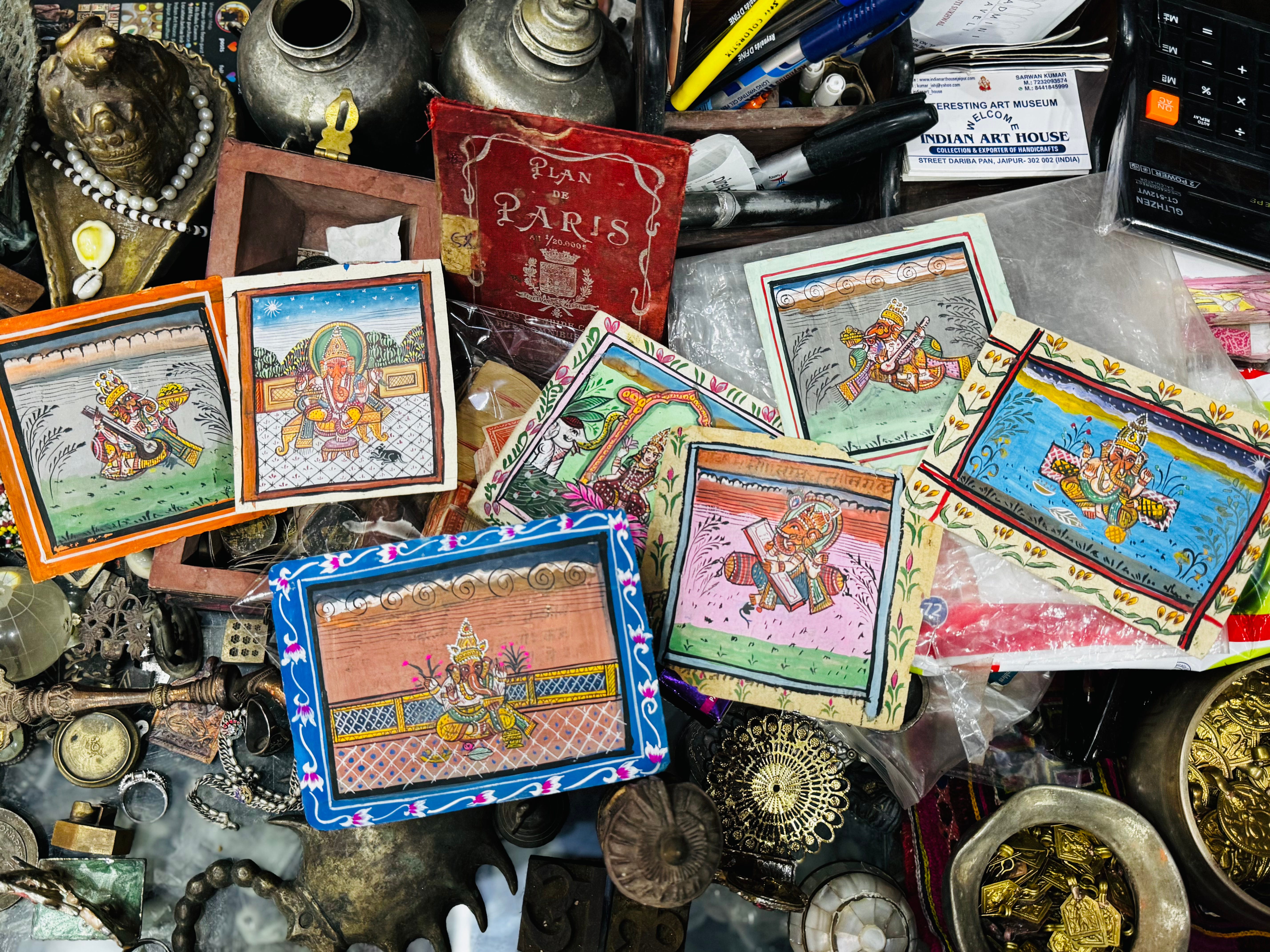
I told them the version I grew up with: Parvati forming a child from the dirt of her skin to stand guard while she bathed; Shiva arriving unannounced and, unable to recognise his own son, beheading him; the elephant head brought as a form of reparation to bring the boy back to life. I even added the extra detail of the one broken tusk Ganesha snapped off to use as a pen when he wrote the Mahabharata as Sage Vyasa dictated it.
But even as I spoke, I could feel the familiar problem. They were hearing the story but were unaware of the architecture holding it up. How do I explain everything that sits around that one tale? It was like trying to explain a single character from the Lord of the Rings without being able to reference the Ring, or Mordor, or the entire gamut of mythology Tolkien built around it, except this universe wasn’t invented by one author but accreted over millennia — wasn’t fiction but faith — and was woven into the daily life of a billion people.
How do I explain that the elephant-headed god’s brother is the six-headed Kartikeya, the god who rides a peacock? That their father, Shiva, is the destroyer of worlds, who holds the river Ganga in the matted locks of his hair and whose neck is blue because he drank poison to save the cosmos? How do I explain the snake coiled around his throat, the crescent moon in his hair, the tiger skin he wears?
How do I explain that Parvati, Durga, and Kali are the same goddess in different moods and forms? That the Trimurti of Brahma, Vishnu, and Shiva governs creation, preservation, and destruction, and that the cities we were visiting all have Tripolia gates named after them, woven so casually into the landscape that most people don’t even notice?
How do I explain Ardhanarishvara, the version of Shiva and Shakti fused into one body? That millennia before the German bishop and polymath Nicholas of Cusa suggested the concept of coniunctio oppositorum, arguing that contradictory ideas can be reconciled in an ultimate reality, on the Indian subcontinent a deity was worshipped that was literally half-male, half-female, meant to symbolise that the universe is built from complement, not opposition.
And how do I explain that Narasimha, half-lion and half-man, looks like a demon but isn’t one, instead being an avatar of Vishnu? That we don’t have a concept of the devil, only beings on spectrums of chaos and order, black and white?
How do I explain all of this without giving a full lecture on metaphysics, and once you start explaining metaphysics, where do you stop?
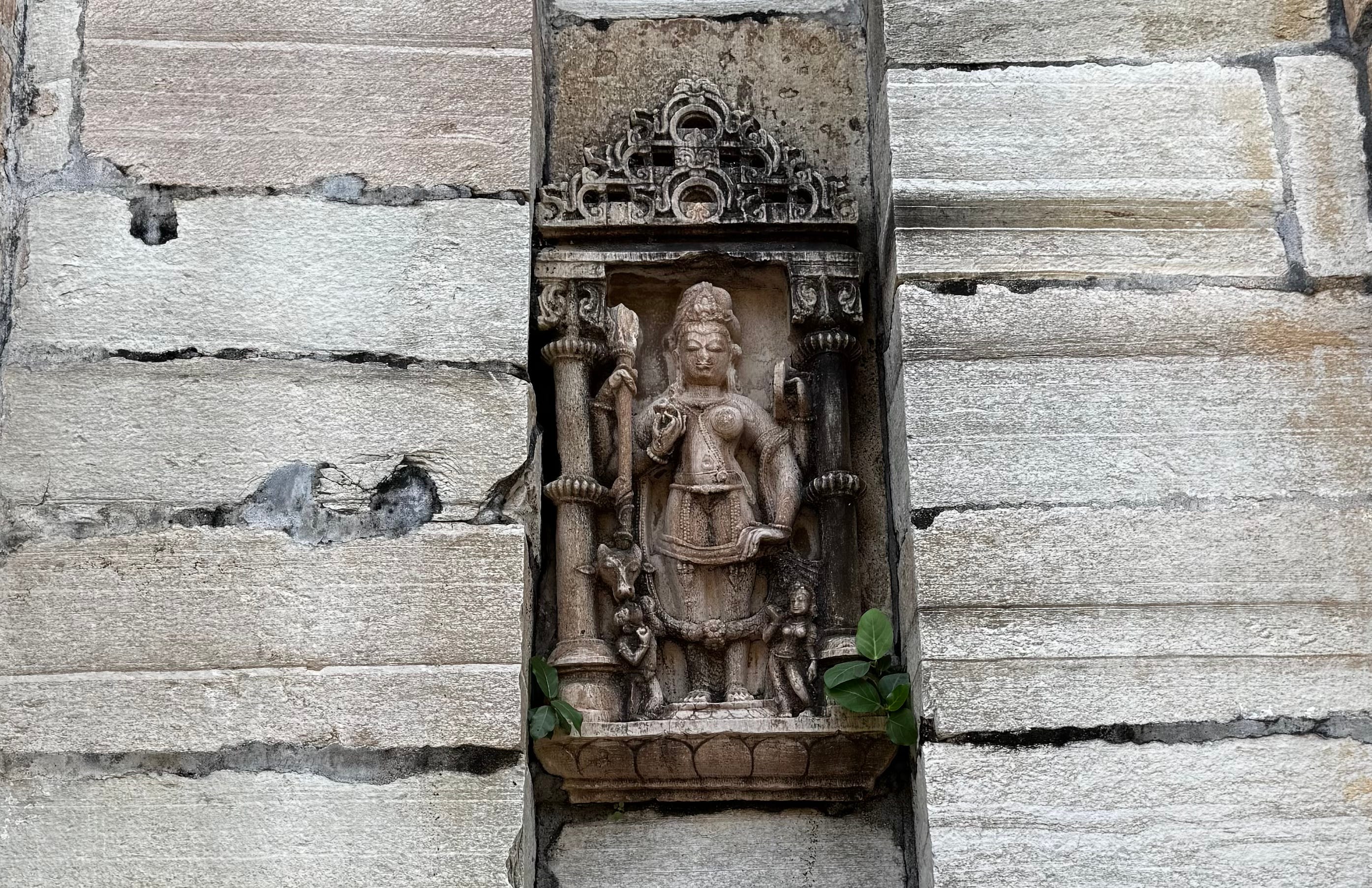
At Chittorgarh — India’s largest fort complex that, at one time, housed over a hundred temples — the guide pointed to yakshas carved into the lowest rungs of temple bases: bent, contorted figures carrying the weight of the structure above them. “They were placed here,” he said, “to trap their chaotic and malevolent energy, so it wouldn’t wander into the village.” Yakshas aren’t gods, but neither are they demons. They occupy a category that doesn’t translate neatly.
At that point another of my friends whispered, half confused, half amused, “Your religion is impossible to follow.” I agreed, because it is expansive. A worldview built from pluralities, not hard doctrines.
Standing in that small gallery in Hawa Mahal with four expectant faces in front of me, I felt a mixture of awe and inadequacy. Awe at the vastness of what I come from, and inadequacy at the impossibility of translating it on command.
It wasn’t that I didn’t try. Over those days in Rajasthan, I talked about the grandeur of Jaipur’s maharajas, about the Mughals and the Indo-Persian architecture that borrowed the best of both worlds. At Amber Fort, I pointed out the natural dyes still visible in the frescoes, how art and culture had been fertile in this land for centuries. At Chittorgarh, I spoke of the valour of Maharana Pratap, of the difference between Maharana and Maharaja, warrior kings and civic kings, and what that distinction revealed about how power was understood here. I talked about all of it, and they listened, and asked questions, and seemed genuinely moved.
But even then, I could feel the weight of everything I wasn’t saying. The context behind the context. The references that needed their own references. For every door I opened, ten more remained shut, and I didn’t have the keys or the time to open them all.
Which is probably why, when the conversation shifted to civic life, I found myself speaking more freely. The dirt, the refuse, the lack of civic sense. Those were things I could articulate without footnotes. Things they could see for themselves.
And there was plenty to see. Jaipur, as I noticed more vividly this time, is shockingly filthy. Just a few meters from the same terracotta-pink walls that make the city so photogenic, the inside alleys told a different story: piss, garbage, shit, plastic. It wasn’t uncommon to see men urinating against walls shared by five-star hotels and heritage havelis, despite the government having built public toilets on nearly every corner. I wanted to acknowledge it, to condemn it — and I did. But I also knew that this was the slice of India that travels easiest, the part that confirms what people already expect, and I was trying to protect the idea of this land from being defined by it alone.
It struck me later that this is the trap of translation: you end up oscillating between extremes. You can describe the dirt because it’s visible, undeniable, requires no context. And you can gesture at the beauty because beauty, too, travels easily. Look at this palace. Look at this fresco. Look at this view. But the substance of that beauty, the why of it, the civilisational grammar that produced it, that’s where language falters. I could show them the Indo-Persian arches and the Mughal gardens and the Rajput frescoes, and they could see that these things were beautiful. What I couldn’t easily convey was why they moved me. The silt of history and myth and memory that had accumulated around them over a lifetime. The awe I felt seeing a rock-cut Ardhanarishvara in an fifteenth-century temple, or sculptures of kings and queens in postures from the Kama Sutra carved on palace walls in a society where that would today be considered obscene. Or the strange vertigo of seeing stories recited and learnt in childhood carved on walls older than entire European civilisations. And so I swung between the dirt they could witness and the beauty they could admire, while the meaning of both remained just out of reach.
After all, it is always easier to talk about the dirt on the streets or the beauty on the walls than the cosmos in your head.
Last night, I went for the launch of Amitava Kumar’s new book at Kunzum in Delhi. During the talk, when asked about form, Kumar referenced Ryszard Kapuściński’s essay Snow in Ghana. I had read the piece years ago, but I revisited it this morning.
In the essay, Kapuściński writes about being stranded overnight in a Ghanaian village and his interactions with the village elder, Nana, who had never met someone from Poland before. The title comes from an innocent question: Nana asks Kapuściński to explain snow. Kapuściński tries and fails, and the failure reveals something crucial. How do you explain more than the dictionary definition to someone who has no lived feeling of it? The cold, the brightness, the touch, the childhood associations, the culture built around something Nana has never seen. Snow isn’t so much a thing as it is a memory, a landscape, and a sensibility. Explaining it out of context shrinks it into an outline.
As Kapuściński confesses:
Suddenly I felt shame, some sort of shortcoming, a sense of having missed the mark. What I had described was not my country. Now, snow … that’s accurate at least. but it is nothing, nothing of what we know, of what we carry around within ourselves without even wondering about: nothing of our pride and despair, of our life, nothing of what we breath, of our death.
That was exactly it. That was my Jaipur problem. My Hawa Mahal problem.
Everything I had been describing to my friends — the gods, the garbage, the temples, the dirt, the maharajas and the Mughals and the warrior kings — was accurate. But accuracy is not the same as truth. None of it fully captured what I carry. And even the grandeur I managed to convey was inevitably flattened, stripped of the thousand associations that make it mean something to me.
A month earlier, through one of those sprawling WhatsApp community networks Indian families maintain across continents, I met an older couple from the same Konkani community as my family in Kochi who offered to help me with my fieldwork. We met near the Periyar, and they told me about their family’s migrations during the Portuguese Inquisition, about how Goan communities rebuilt ritual life in pockets across Karnataka and Kerala, and about the food and festivals and stories that survived only because families carried them across borders.
At one point the aunty said, “Being a writer interested in our culture is a big responsibility; it’s important you document our traditions. Even my own children don’t know most of it anymore. I don’t know how to pass it on.”
It wasn’t despair so much as recognition; a recognition that culture survives only through attention, and attention today is not guaranteed.
Listening to her, I understood why even trying to translate India for my friends felt so fraught. Some things are too large, some things are too layered, and some things refuse the format of explanation. And when you have four expectant faces with fertile imaginations and limited time, you want to give them everything at once. Which means you end up giving them fragments, and you have no control over which fragments come to stand for the whole.
R.F. Kuang’s Babel, a novel that captures the impossibility of translation, has a line that has stayed with me:
Translation means doing violence upon the original, means warping and distorting it for foreign, unintended eyes. So then where does that leave us? How can we conclude, except by acknowledging that an act of translation is then necessarily always an act of betrayal?
Although at times my inadequacy felt like a betrayal to India, perhaps I need to acknowledge that these were not unintended eyes. My friends wanted to know. They had come with curiosity, not judgement, and they asked questions not to reduce but to understand. So my feelings of incompetance aside, I tried my best. And maybe that is all translation can ever be: an act of good faith between people who want to meet somewhere in the middle.
And partial explanations are not useless. On that journey through Ghana, when Nana assumed Poland was a colonial power, it wasn’t Kapuściński who corrected him. It was Kofi, his Ghanaian companion from Accra, who said:
They don’t have colonies, Nana. Not all white countries have colonies. Not all whites are colonialists. You have to understand that whites often colonised whites.
The man who had asked Kapuściński the same naive question at the start of the trip now had enough context to correct someone else. Which made me think of my own friends. Maybe I can’t explain the whole universe to them, but I hope they leave India with just enough context to correct the next person who reduces this place to dirt or chaos or a pretty little cliché.
Describing India, even to those who arrive with goodwill and curiosity, is always incomplete. There is the India I can point to, and there is the India I carry within me, which no combination of vocabulary, syntax, or carefully arranged sentences will ever fully reveal.
Some things must be seen. Some things must be lived. And the rest, like snow in a place where winter never comes, can only be understood by those who have already stood inside it.
I really loved this piece. I'm a Tamil diaspora returned to the North of Sri Lanka, here to work on some cultural preservation and my own novel. Though I never lived here, I am finding myself moved by things and people and places here that remind me of my childhood. It's a cellular level connectivity I didn't realize I was missing in my life. And I keep finding myself at a loss of how to describe this feeling. Perhaps the word hasn't been invented yet?
Lovely read, Nishad. The piece does such a great job of capturing the nuances and contradictions in all things Indian.