

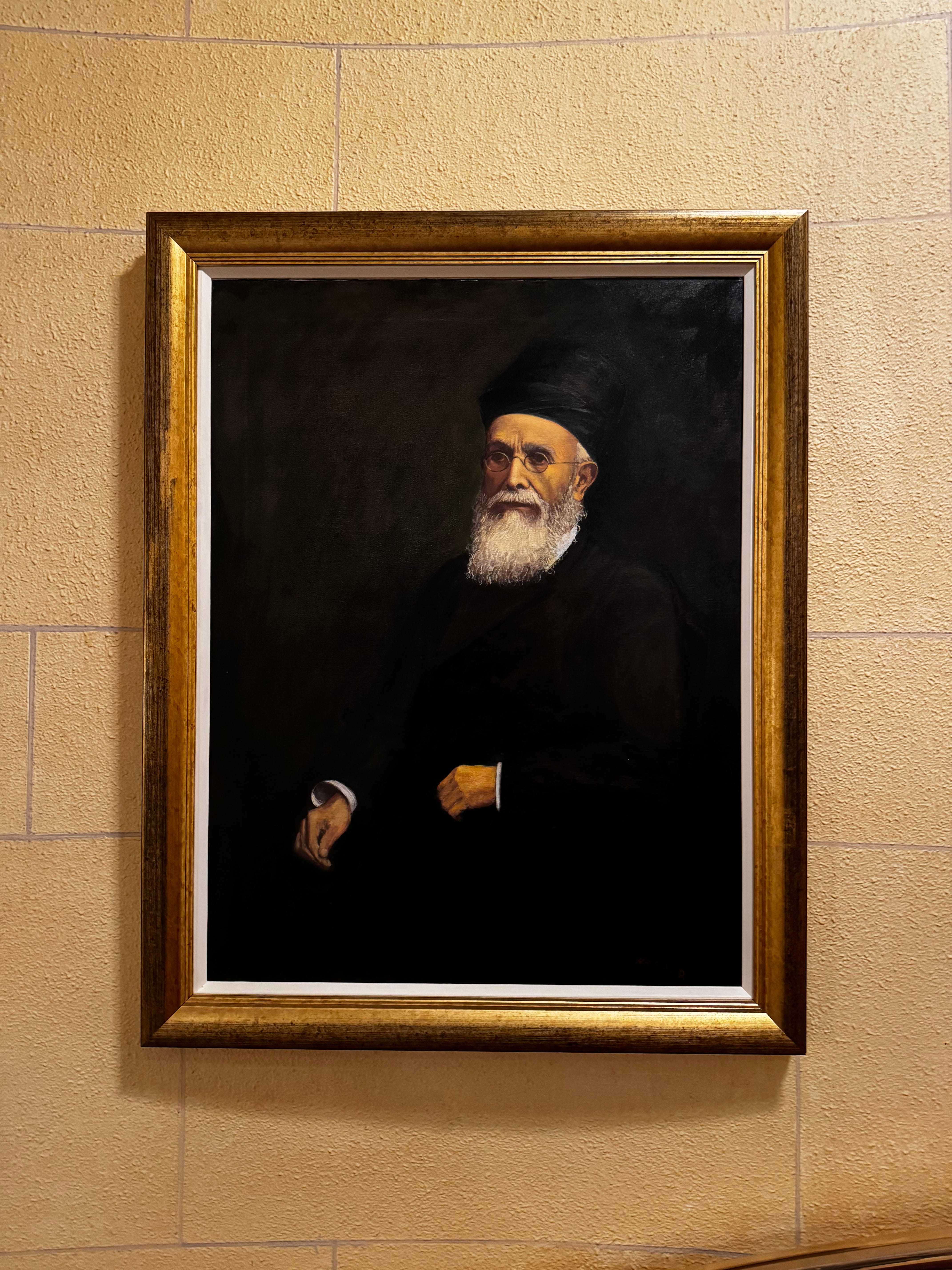
On 2 May 1867, in a rented London hall, a Bombay cotton merchant read a paper to a room of Englishmen, titled: ‘England’s Debt to India’. Nearly a quarter of India’s revenue, Dadabhai Naoroji argued, left the country each year for England, leaving India bleeding. He put the drain at thirty to forty million pounds a year, and in 1892 became the first Indian to sit in the House of Commons, itemising the cost of empire from inside its own parliament.
A century and a half later, another person of Indian origin in British politics reached the opposite total. Responding to Jamaica’s plan to petition King Charles over slavery reparations, Suella Braverman, the former home secretary who now sits with the far-right Reform UK party, wrote on X last week that “the British Empire did so much good for the world.” Slavery was “abhorrent,” she allowed, but asking twenty-first-century Britons to pay for eighteenth-century crimes had “no basis in law.” If anything, “former colonies should pay the British back” for Britain’s “investment, effort and contribution.”
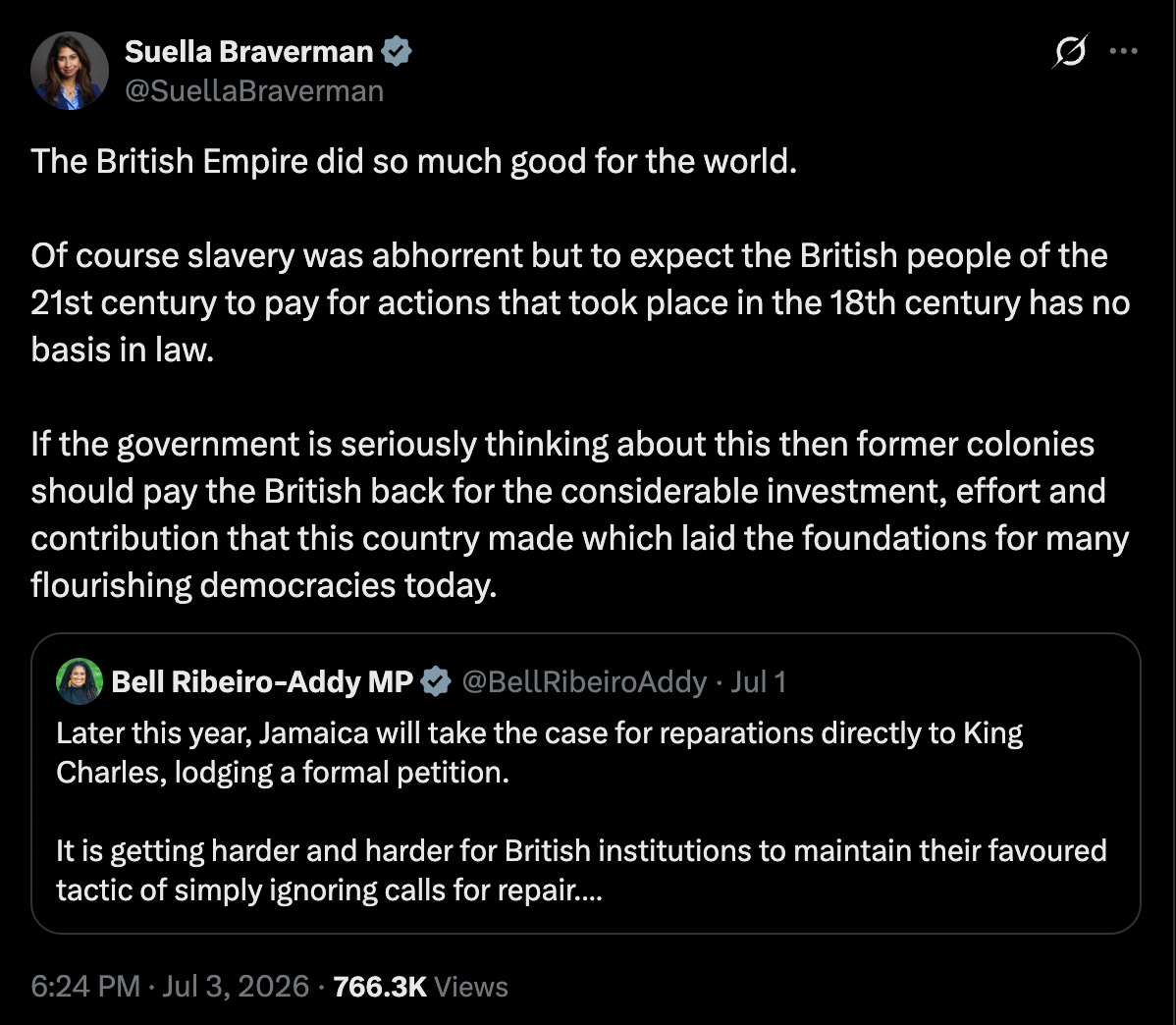
The irony is almost too neat: the first Indian in the Commons used the seat to hand Britain the bill; a British-Indian MP now uses her platform to hand it to the colonies. Brownness, of course, has never been a vaccine against colonial amnesia, and the colonised can become fluent in the coloniser’s excuses.
But let’s see if the argument holds. The railways are always summoned first to highlight the benevolence of the empire. Yes, Britain did lay tracks across India, but the lines carried troops, cotton, grain and revenue to the ports, under a guarantee that gave British investors a fixed return whatever happened while the risk sat on Indian taxpayers. The railway was never a charity on wheels; it moved an occupier’s soldiers in and an occupied’s cotton out. A robber who builds a road to your house so the carts can haul your possessions to the harbour has still looted you, and that the road stays useful after he is gone does not make the robbery an infrastructure development programme. The “empire did good” school mistakes a consequence for an intention.
Nor did Britain sail to India to admire its muslin. The subcontinent was once among the world’s great manufacturing centres, producing by some estimates about a quarter of global industrial output in 1750, a share that had collapsed to roughly two per cent by 1900. Defenders call it modernisation. Rearrangement is more honest: Indian hands supplying raw cotton, Lancashire mills turning it into cloth, and Indians invited to buy back at a markup what had been taken, at gunpoint, from their own economy.
Then there’s the trade in opium. In Bengal and Bihar the East India Company ran the opium monopoly; cultivators were forced to take advances against a fixed quota, and falling short (a judgment made by the hand that held the lathi), meant the money was clawed back. This was not a crop drifting innocently towards China but an industry of compulsion, worked by hundreds of thousands of Indian peasants, feeding a drug Britain pushed into China to fix its own trade deficit. When the Qing tried to stop it in 1839, Britain sent an army. The National Army Museum’s own account puts it plainly: it was a war fought by British-Indian forces in the interests of opium smugglers. China lost and was made to reopen its ports to the trade it had banned, including handing over Hong Kong. So what goes in the opium column of Braverman’s invoice? The addiction, the war, and the cultivator at the head of a global narcotics chain that paid him in debt?
Braverman’s refuge is the law. But the law cannot clean the slate. Slavery had law; extraction had law; even indenture had contracts and the Company had charters. The genius of empire was never that it broke the law; it was that it made domination administratively respectable, with courts that knew exactly how to recognise a man as property when they needed to.
And if the present truly cannot pay for the past, Britain has already proved otherwise with its own money. When slavery was abolished in 1833, the enslaved received nothing; the forty-six thousand people who had owned them shared twenty million pounds, about forty per cent of the government’s annual spending. The loan raised to pay it was, by the Treasury’s own account, not cleared until 2015, and twenty million pounds then is worth more than two billion today on the Bank of England’s own online calculator. So twenty-first-century Britons did pay for the age of slavery. They just paid the people who had owned human beings.
India’s account was never only economic. It is written in lives: the soldiers sent to die for a system that denied them equality, the bodies in Jallianwala Bagh, the three million dead in the Bengal famine of 1943, a catastrophe tied to wartime priorities set in London. It is written in objects too. The Koh-i-Noor still sits in the Tower of London, set in a royal crown, surrendered under the Treaty of Lahore after the annexation of Punjab. Signed away, the apologists love to say, which is true; they are quieter about who signed: a boy of ten under duress.
So dear Suella, we have already paid. We paid in land, labour, tax, cotton, opium, soldiers, hunger, diamonds, and lives. We paid in the inherited reflex of being asked to say thank you for the empty jute bags left behind in a hurry after the house had been emptied. Naoroji read the debt aloud in London in 1867, and it has been sitting there, unpaid, ever since.
The empire does not need another thank-you note. It needs an honest audit.
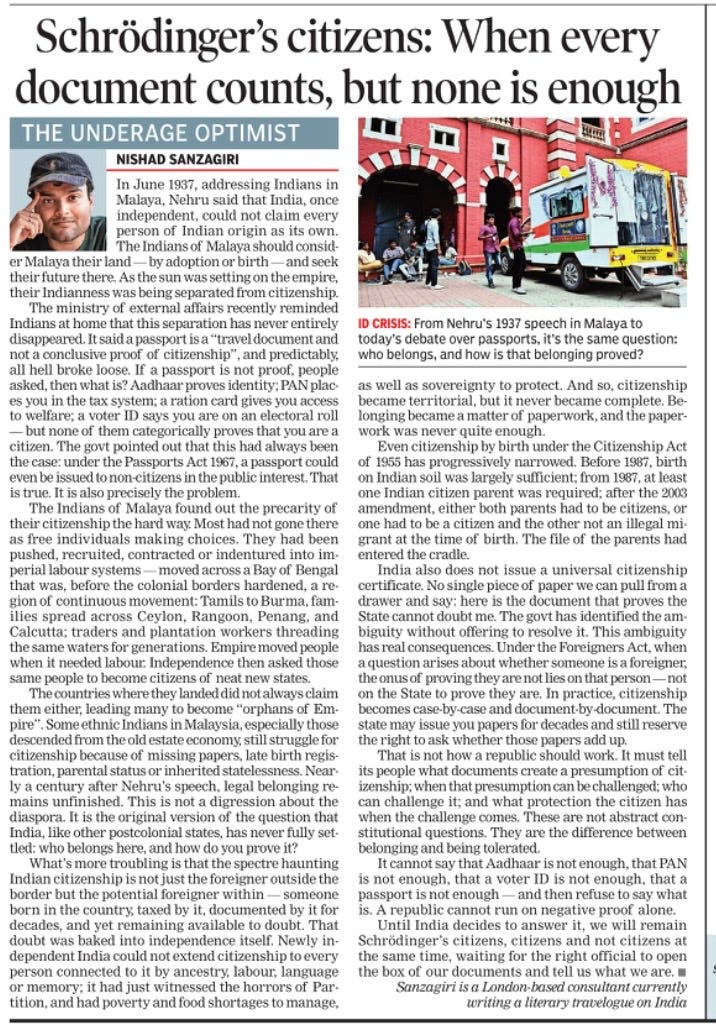
On an unrelated note, always a small thrill to see a piece in print. I wrote for The Times of India’s Sunday edition this weekend on citizenship, and how ambiguity was baked into the idea of India from the very beginning. The print version is below, and you can read the full piece online here.
Great article, Nishad. Your mention of Indian soldiers being sent to fight in the two world wars reminded me of Guleri’s story “usne kaha tha” (if you’ve read rhe story, you’d probably recall the dialog, “teri kudmai ho gayi?”) Ms. Braverman has only a Britisher’s viewpoint in mind…her mother, though of Indian origin, was born in Mauritius, so even though she looks rather Indian, she has no real connection with India.
Brilliant piece Nishad! Your article beautifully unravels the history that so many of us are sadly oblivious to. An eye opening read for sure!