
Can you really die of sadness?
On Marjane Satrapi, broken-heart syndrome, and the nature of love and longing

“Marjane Satrapi died of sadness,” said the statement issued by the family of the author of Persepolis, “a little over a year after the death of Mattias Ripa, her husband and the love of her life.”
I read the sentence in that strange half-awake way one reads the news now, and for a moment I did not know how a sentence so simple could move me so much.
I was not expecting then that the phrase would keep me up for days, attaching itself to books, conversations, memories, and scraps from my notebook.
Death by sadness. It sounded like something from another time, from a world in which human emotions were allowed to take centrestage, in which people did not yet feel compelled to translate every collapse into the language of organs, enzymes, scans, reports, and causes. A person died of fever; a person died of fright; a person died because the monsoon failed; because the gods turned away; because an omen had been ignored.
And yet the phrase did not feel untrue.
It was the mundane ubiquity of it. Every family has some version of this story, even if a few generations removed: a woman who followed her husband into death before anyone could agree whether it was illness or will; an aunt who, after the call from the hospital, began taking to bed a little too often; an old uncle who stopped correcting everyone at the dining table; a grandfather who, after his wife died, walked more slowly across the room, hesitated before reaching for the TV remote, or just seemed briefly confused by the ordinary machinery of the house.
Today we like to think that people do not simply die of sadness. We expect a more precise explanation, something with the authority of medicine: a blocked artery, an arrhythmia, metastatic disease, respiratory failure, sepsis, the slow collapse of an organ that can be pointed to on a scan.
And yet, in Japan in 1990, doctors described a condition they called takotsubo cardiomyopathy, after the octopus trap whose shape the heart’s left ventricle can come to resemble when it is stunned by severe stress. Newspapers called it broken-heart syndrome, which sounds almost too sentimental, until one learns that grief, shock, illness, a violent argument, the loss of a loved one, or even fear itself, can sometimes produce symptoms indistinguishable from a heart attack.
There is a gendered aspect here too. More than ninety percent of reported cases are in women between the ages of fifty-eight and seventy-five, which makes one think of all the older women whose hearts have been asked, for decades, to absorb the shocks of everyone else’s lives — husbands, children, and families — the price of being, for multiple generations, the Minister for Emotional Regulation of every household.
Most people recover. But in rare cases it can be fatal. So perhaps “died of sadness” is not quite as foolish as our modern selves want it to be.
James Baldwin once warned:
Loving anybody and being loved by anybody is a tremendous danger, a tremendous responsibility.
I used to read that line as a warning about the obligation of not wounding the person who has entrusted themselves to you. But perhaps it is simpler than that too. To love someone is to let the body learn another person: their presence, their moods, their hunger, the sound of them moving in the next room. One’s happiness becomes partly — or entirely — dependent on another’s happiness. One’s irritation too.
And when that person is gone, what happens then?
Joan Didion, writing after the death of her husband John Gregory Dunne, says in The Year of Magical Thinking:
I remember thinking that I needed to discuss this with John.
There is almost nothing in the sentence, which is perhaps why it is the single most articulate statement on grief I’ve ever read. It is the utter ordinariness of the thought that makes it so lethal.
I am currently reading Kiran Desai’s The Loneliness of Sonia and Sunny, and in it, a widow remembers the sweetness of having someone with whom to talk about the little things.
How sweet it was when one could undo the lethargy of time by chatting with someone about the little things. You could always find a person to converse with over the larger matters — a government scandal, the delayed monsoons — but it was the tiny concerns, the moment’s observations, that you couldn’t save up to tell, for you didn’t even recognize their full potential to add meaning to life unless you articulated their humor, tragedy, menace, or charm.
At coffee in Lodhi Gardens, a friend said that given everything Satrapi had been through — revolution, exile — she had somehow hoped she would survive heartbreak too.
But sometimes it is not the great catastrophes of a well-lived life that undoes a person but the smallest pressure afterwards, the way a branch, already weathered by the monsoon, can finally snap under the weight of a myna.
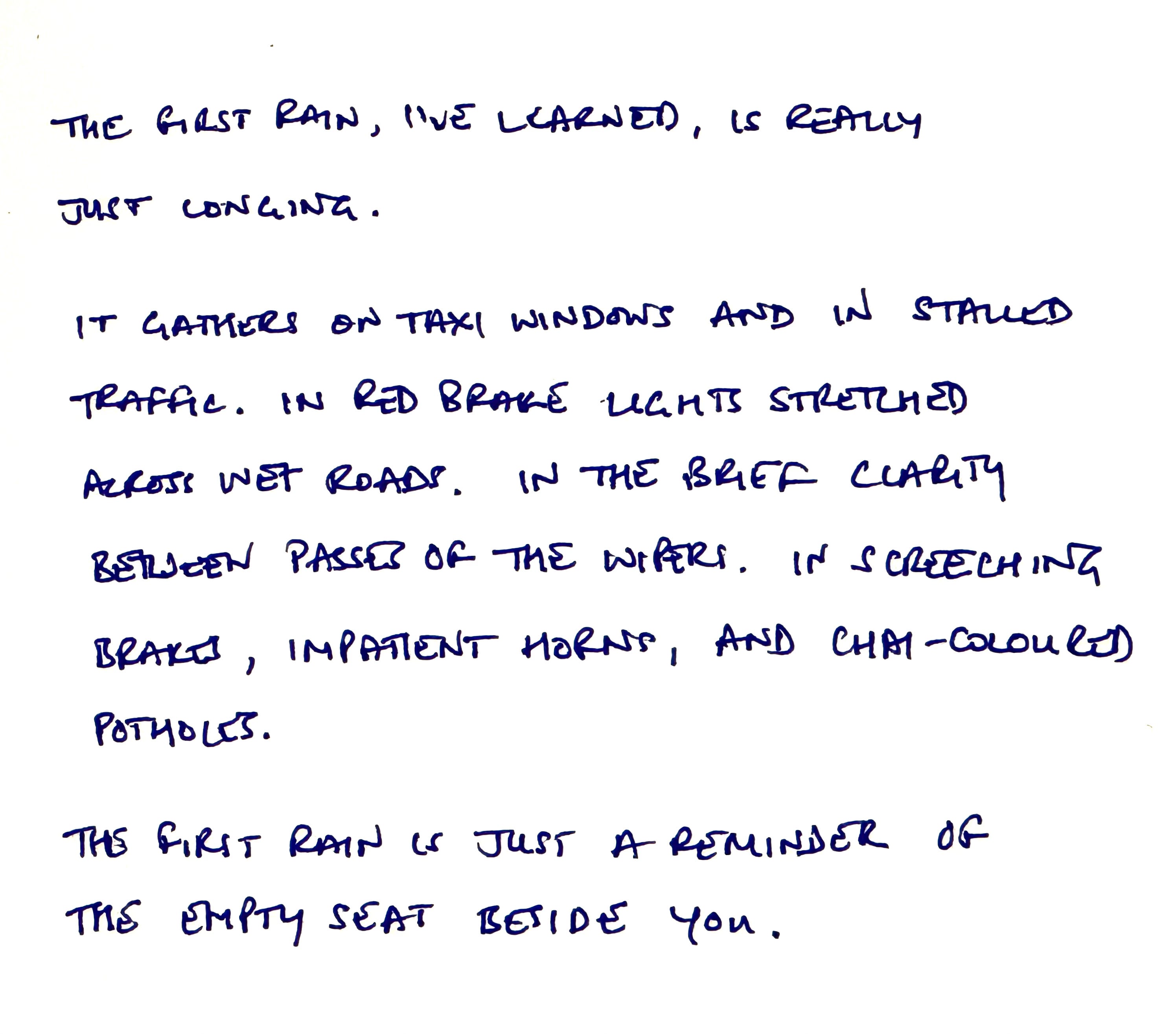
Two weeks ago, travelling by road while looking out at this year’s first rains, I wrote in my notebook:
My mother and I have a habit of stopping for flowers: a champa fallen on the road, a hibiscus opened too widely in someone’s compound, a frangipani tree leaning over a wall, or the orange-speckled parijats that bloom in the night and fall by morning, as if they were interested only in being admired by the moon.
The other night, while walking after dinner, she said, “Anyone who doesn’t stop to smell the flowers has a melancholic ambivalence about them,” which was such a needlessly elaborate sentence that I laughed and made a mental note to write it down.
A little later we passed the mogra plant by our building. The flowers had opened after dark, sending out their particular sweetness into the lane, over parked scooters and water stains and stray dogs.
We stopped and stood there for a moment.
Then she walked ahead.
I plucked a single flower and ran after her.
She took it, smiled, and continued walking.
Later that night, when I went to say goodnight, I saw that she had kept the mogra beside her pillow.
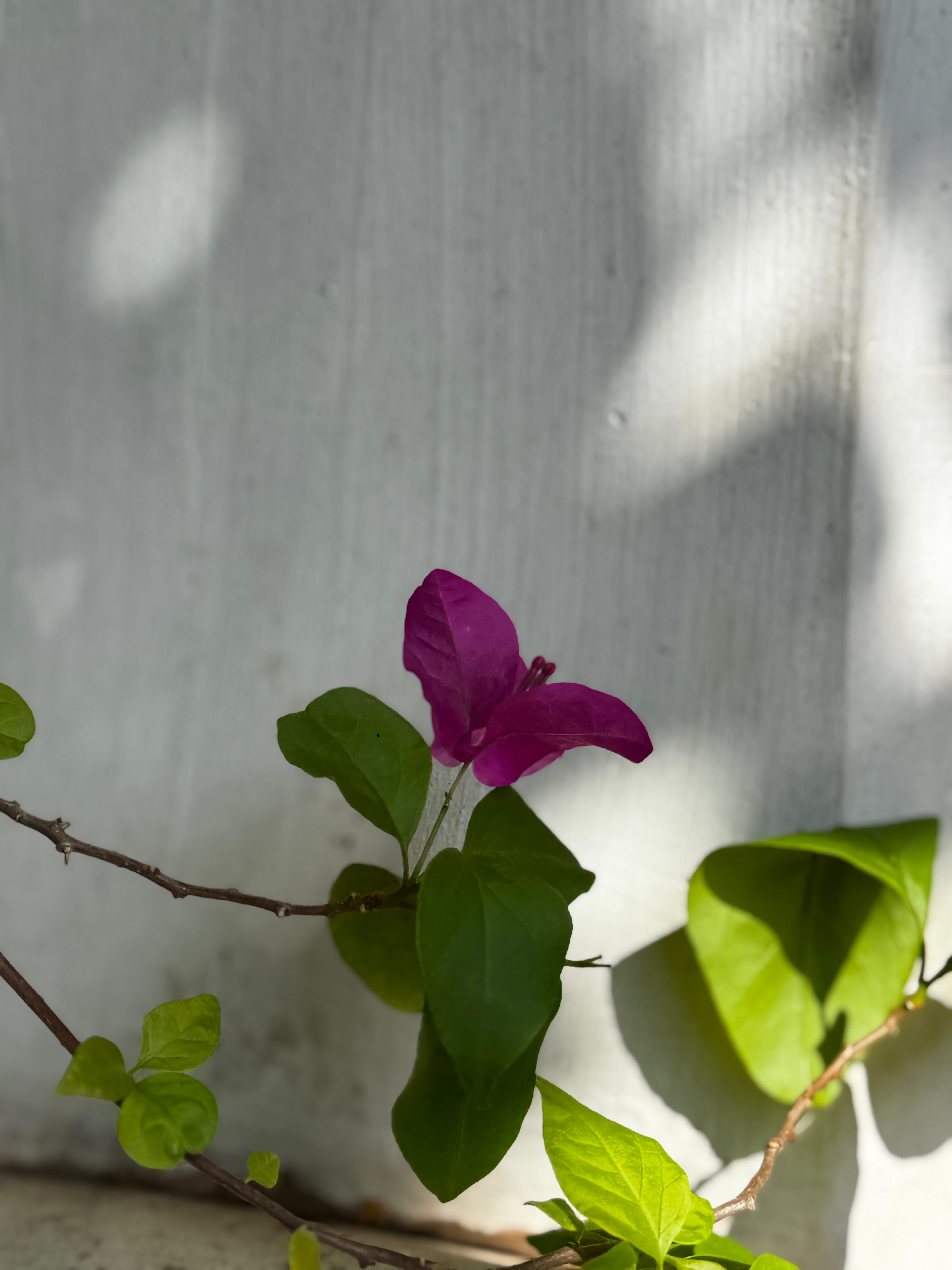
A few days later I saw two bougainvillaea flowers, their papery pink bracts arranged so perfectly that they looked like the wings of a butterfly. I took a photograph of them, because for a second they really did look as if they might lift from the vine.
Heartbreak is not the opposite of love but one of its afterlives: it is the interruption of an old habit, that of turning towards someone.
Love is a mogra pressed beside your mother’s pillow.
It is looking out at the season’s first rain and saying: Hey, come here. Sit with me.
It is seeing two bougainvillaea flowers that look like the wings of a butterfly, taking a picture, and sending it to someone.
Love is often just the presence of someone to whom you can point the most ordinary thing and say: Look.
Loved it. And yes, that died of heartbreak had haunted me too, the thought that perhaps heartbreak was something real and tangible. Have heard enough stories of folks who pass away a few days or months after they lose their partners to know this does happen.
Absolutely love your posts. I too stop to smell the flowers, pick them from where they've fallen...watch the sky for a brief moment, stuff that we miss if we're not paying attention. That broken heart statement really shook me.